Persian through Modern Persian Poetry: From Nima to Forugh Farrokhzad
September 18 - November 6, 2026
Instructor: Maryam Torabi
Instruction Language: Persian
Duration: 8 weeks (16 hours of instruction)
Frequency: 1 classes per week (Fridays)
Duration of a Session: 2 hours (9pm Yerevan Time)
Deadline for Applications: September 11
Classes Start: September 18
Location: Online (Zoom)
Required level of Persian: Intermediate
Text Editions:
- Nima Yushij, Majmu’e-ye Kāmel-e Ash’ār. Negāh 2012, Tehran;
- Ahmad Shamlou, Bāgh-e Āyīnī. Morvārīd publication. 1960, Tehran;
- Fereydoun Moshiri, Sī Daftar. Češmī publication. 1976, Tehran;
- Sohrab Sepehri, Hašt Ketāb,. Zehn Āzīn publication. 1990, Tehran;
- Forough Farrokhzad, Dīvān-e Ash’ār, Gol Āzīn publication. 2007, Tehran
Selected Poets:
Nima Yushij, Ahmad Shamlou, Fereydoun Moshiri, Sohrab Sepehri, Forough Farrokhzad
Participation Fee: 290 USD
Payment Method: Bank Transfer, Paypal (+5%)
Registration: To apply, please click the “Apply” button above. Fill in all required fields and submit. Accepted applicants will receive further instructions on participation.
Note: All materials will be provided by the instructor
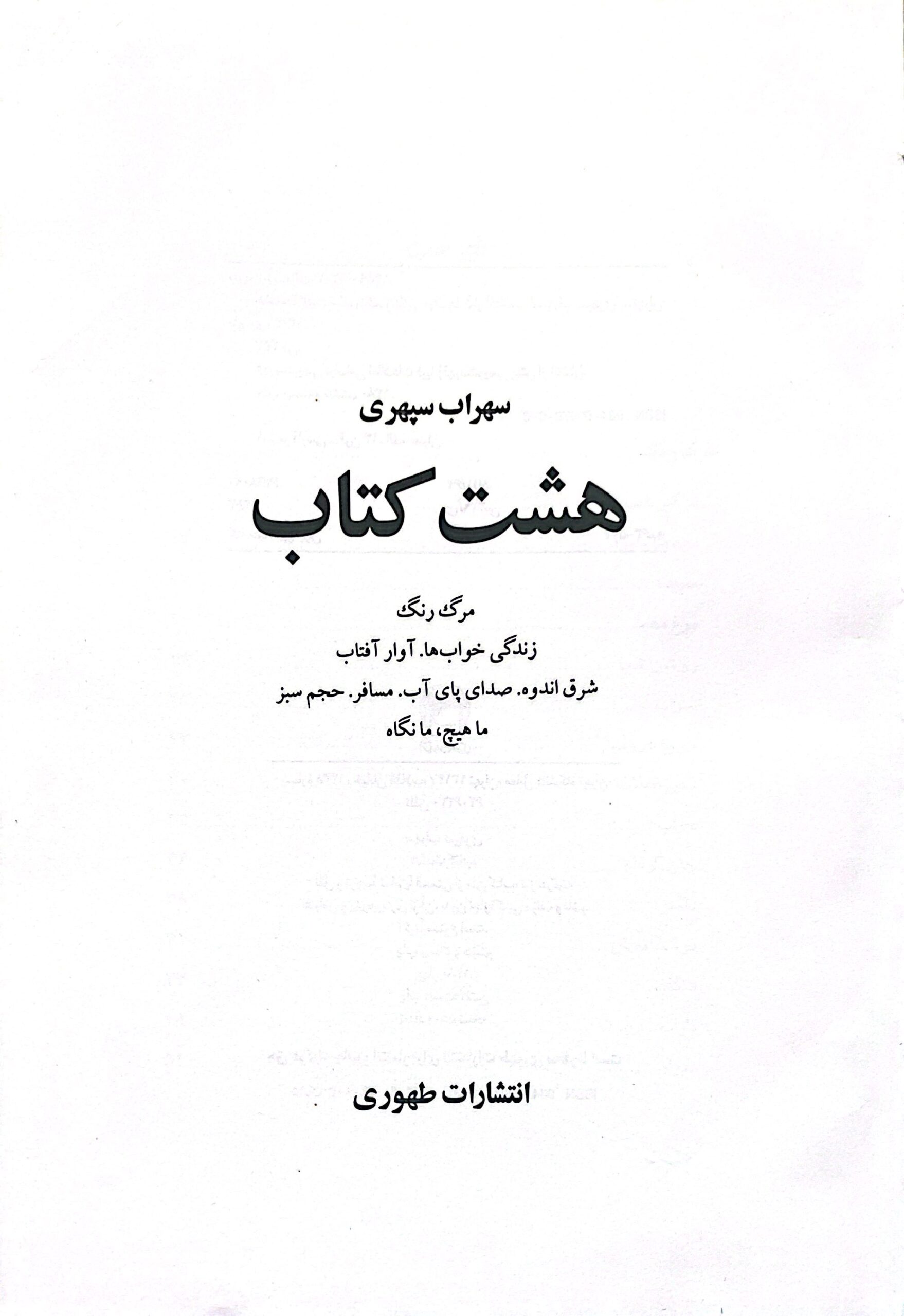
The Front page of Sohrab Sepehri's Hašt Ketāb (Entešārāt-e Tahūrī, Tehrān, 2001)
Persian through Modern Persian Poetry: From Nima to Forugh Farrokhzad is designed as an intensive and immersive introductory course to modern Persian poetry. Through intensive Persian-language instruction and close reading of poetic texts, participants will become familiar with the origins, development, and major transformations of modern Persian poetry, from the pioneering work of Nima Yushij to the poetry of Forough Farrokhzad.
The course is designed to provide participants with a space in which they can develop their Persian speaking, listening, and reading skills while becoming familiar with the rich tradition of Persian poetry. Most of the instruction will be conducted in Persian. Participants will therefore be encouraged to speak, express their ideas, and actively engage with the texts in Persian, developing their language skills in an environment specifically designed for this purpose.
Course Overview
This 8-week online course offers an in-depth introduction to modern Persian poetry, focusing on five major Iranian poets of the 20th century: Nima Yushij, Ahmad Shamlou, Fereydoun Moshiri, Sohrab Sepehri, and Forough Farrokhzad. Through close reading, discussion, and interactive language-based activities, participants will engage directly with the original Persian texts, actively learning and practicing the language as an integral part of the course.
The course consists of 16 hours of instruction, with one two-hour session each week. Each session focuses on selected poems and works that illustrate important stylistic and thematic developments in modern Persian poetry. We will consider how questions of voice, form, identity, and tradition are negotiated in poetry, and how literary innovation emerged in dialogue with both the Persian poetic tradition and broader cultural and intellectual currents.
Participants will be encouraged to read the original texts critically and contextually, paying close attention to the language, structure, imagery, and meaning of each poem. This will help develop the skills necessary to appreciate both the explicit and more subtle aspects of modern Persian poetry.
The course is designed to provide participants with the tools and confidence to engage thoughtfully and independently with modern Persian poetry in both academic and literary contexts.
By taking this course, you will:
- Developing Persian speaking and listening skills.
- Learn 800+ new words
- Learn how to engage and read contemporary Persian poems.
- Get to know key poets and movements from the early 20th century to today.
- Explore major themes like identity, society, gender, revolution in the Iranian context.
- Develop a cultural appreciation of the cultural and political topics discussed in modern Persan poems.
- Gain a deeper understanding of how poetry reflects and shapes modern Iranian culture and experience.
Course Structure
The course is structured around five major modern Persian poets, with each poet explored through a selection of poems read and discussed in detail.
Sessions are interactive and flexible. While relevant background on the poets, their works, and the broader literary and cultural context will be provided, the emphasis remains on close reading, speaking, and active engagement with the language, via speaking and listening practices.
The primary activities of each class session include:
- Discussion of assigned readings in Persian. Emphasis on speaking. (20 minutes)
- Reading and analysis of the primary text. Emphasis on reading and listening (40 minutes)
- Break (10-15 minutes)
- Continued textual reading and interpretation. Reading and listening (40 minutes)
- Discussion and participant reflections. Speaking (20 minutes)
Participants are encouraged to contribute their perspectives and to approach the poems not only as literary works, but also as expressions shaped by the cultural, social, and political realities of modern Iran. At the same time, the close engagement with the original Persian texts provides an opportunity to develop a deeper familiarity with the language and to gain confidence in reading and discussing modern Persian poetry.
Course Schedule and Selected Poems
Session 1 — Nima Yushij
Selected poems:
- ققنوس (Qoqnus)
- تو را من چشم در راهم (To Rā Man Čašm Bar Rāham)
- میتراود مهتاب (Mi-Tarāvad Mahtāb)
- آی آدمها (Āy Ādam-hā)
Sessions 2–3 — Ahmad Shamlou
Selected poems:
- مرگ را دیدهام من (Marg Rā Dide-am Man)
- دوستش میدارم (Dust-aš Mi-Dāram)
- غزلی در نتوانستن (Qazali Dar Natavānestan)
- کلید (Kelid)
Session 4 — Fereydoun Moshiri
Selected poems:
- بوی باران، بوی سبزه (Buy-e Bārān, Buy-e Sabze)
- کوچه (Kuče)
- آخرین جرعهی این جام (Āḵarin Jor’e-ye In Jām)
- کوچ (Kuč)
Sessions 5–6 — Sohrab Sepehri
Selected poems:
- و پیامی در راه (Va Payāmi Dar Rāh)
- آب را گل نکنیم (Āb Rā Gol Nakonim)
- در گلستانه (Dar Golestāne)
- پشت دریاها (Pošt-e Daryāhā)
Sessions 7–8 — Forough Farrokhzad
Selected poems:
- تولدی دیگر (Tavallodi Digar)
- عاشقانه (Āšeqāne)
- عصیان (Eṣyān)
- بعد از تو (Ba’d Az To)
Teaching Approach
Although the course is centered on modern Persian poetry, its primary aim is to develop participants’ Persian speaking, listening, and reading skills. Most of the instruction will therefore be conducted in Persian, and participants will be encouraged to speak, discuss the texts, and express their ideas in Persian throughout the course.
The instructor will provide continuous feedback on grammar, pronunciation, and vocabulary, helping participants address the difficulties they encounter as they use the language. At the same time, the focus on language does not come at the expense of the literary dimension of the course. On the contrary, a deeper understanding of Persian will allow participants to engage more closely and meaningfully with the poems and appreciate aspects of the texts that may otherwise remain difficult to access.
A substantial part of the course will also rely on independent work between sessions. Participants will be expected to read the assigned poems, engage with additional multimedia materials, and continue working with the language outside the classroom. This combination of classroom instruction, independent reading, and exposure to different forms of Persian will provide sustained practice and help participants develop greater confidence in using and understanding the language.