Urdu Curriculum
Ferdowsi Summer School of Persianate Languages and Literatures
July 6 - 31, 2026, Yerevan
The Urdu programme (taught by K. Szitar) is designed to develop a reading proficiency in Urdu through close engagement with original literary texts from the Persianate world.
The primary focus is on strengthening grammatical competence and reading strategies, allowing students with prior knowledge of Persian to approach Urdu texts with confidence and accuracy. Grammatical structures are introduced systematically with particular attention to features shared with Persian as well as points of divergence.
Rather than treating Urdu as an isolated language, the course emphasizes its historical formation through sustained contact with Persian, Chaghatay, and other Persianate languages of Central and South Asia. Urdu prose and poetry are approached as part of a transregional continuum linking Central Asia, Iran, North India, the Deccan, the Caucasus, and the Ottoman world. Readings span multiple periods and genres of Urdu literary history.
The course begins with excerpts from the Urdu translation of the Baburnama, using this text to introduce core grammatical foundations while highlighting Chaghatay–Persian–Urdu continuities in early modern prose culture. Later weeks focus increasingly on poetry, including early Dakhani verse, classical authors from Delhi and North India, and selected modern poetic texts. Students are introduced to major poetic forms such as the ghazal, rubāʿī, and qaṣīda, as well as the influence of Persian and Arabic on Urdu vocabulary and literary expression.
Learning Outcomes
By the end of the course, students will be able to:
• Read and interpret short Urdu prose and poetic texts with confidence, using appropriate reading strategies and reference tools
• Recognize and analyze points of continuity and divergence between Urdu and Perso-Arabic grammar, drawing on their prior knowledge of Persian
• Recognize and interpret common Persian and Arabic lexical, morphological, and idiomatic elements in Urdu literary texts
• Identify and describe major Urdu literary forms such as the ghazal, rubāʿī, and qaṣīda, and understand their formal conventions
• Situate Urdu prose and poetry within the broader Persianate literary world, including its historical connections with Chaghatay, Central Asia, Iran, and South Asia
• Develop historically informed reading practices that link linguistic analysis to questions of genre, circulation, and literary culture
Teaching Methods
• Guided close reading of original Urdu prose and poetic texts, with sustained attention to grammar, syntax, and meaning.
• Comparative reading of Urdu–Persian interlinear translations to examine syntactic structure and patterns of divergence and convergence
• Comparative linguistic analysis drawing on students’ prior knowledge of Persian and parallel exposure to Chaghatay
• Use of multimedia resources, including images and short videos, to contextualize texts and introduce Urdu calligraphy and the historical development of the Persian script in South Asia
• Brief contextual lectures and discussions on literary history, etymology, and intertextual references within the Persianate cultural canon
• Collaborative reading and interpretative exercises that encourage peer discussion and connections between Urdu materials and themes encountered in the Persian and Chaghatay classes.
Week 1: Grammar Foundations and Persianate Prose
Theme: Chaghatay–Persian–Urdu continuities in early modern prose
Focus: Introduction to Urdu script (retroflex, nun-e gunna, etc.), core grammar, and reading strategies through the Urdu translation of the Baburnama.
Session 1
• Introduction to Nastaʿliq: orthographic conventions and phonology in comparison with Persian
• Overview of Urdu sentence structure (SOV) and basic clause patterns
• Nouns, gender, and postpositions
• Guided close reading: Baburnama (selected excerpts)
• Discussion of Chaghatay–Persian–Urdu prose culture
Session 2
• Verbal system: infinitive, habitual, perfective, and narrative tense
• Ergative constructions (ne)
• Comparative reading of Urdu–Persian interlinear passages from the Baburnama
• Guided reading: travel, description, and conquest narratives
Session 3
• The Persian and Arabic derived grammatical structures in Urdu
• Plural formation and recognition of Persian and Arabic morphological patterns
• Lexical and etymological analysis of Persian–Arabic compounds in Baburnama excerpts
Week 2: Early Urdu Poetry and Regional Contexts
Theme: The Deccan and the emergence of Urdu poetic language
Focus: Regional variation and early poetic forms.
Session 4
• Introduction to Dakhani Urdu: historical context and linguistic features (Excerpts from Muḥammad Qulī Qutb Shāh, Nuṣratī, Valī Dakanī)
• Reading early Dakhani poetic excerpts and Persian influences (Ḥāfiẓ)
• Lexical and grammatical comparison with North Indian Urdu and Persian
• Multimedia materials on script, manuscript culture, and miniatures.
Session 5
• Introduction to Urdu poetic forms: the ghazal (Excerpts from Mīr Taqī Mīr, Mīr Dard, Dāgh
Dihlavī)
• Formal conventions, themes, and rhetorical devices
• Poetic syntax and relative constructions
• Guided close reading and collaborative interpretation
Session 6
• The qaṣīda in Persian and Urdu literary culture (Saudā)
• Compound verbs and idiomatic usage in poetic language
• Comparative discussion of rhetorical registers in Persian and Urdu poetry
• Intertextual references within the Persianate canon
Week 3: Classical Urdu Poetry and Persianate Thought
Theme: Delhi, bilingualism, and literary refinement
Focus: Advanced poetic reading and syntactic complexity; Persian–Urdu bilingual literary culture.
Session 7
• Urdu–Persian bilingualism and literary self-fashioning (Ghālib)
• Conditional constructions and complex sentence patterns
• Guided reading of classical ghazal excerpts
• Comparative syntactic analysis with Persian models
Session 8
• Abstract nouns, passive constructions, and philosophical vocabulary (Dard)
• Reading poetic texts engaging ethical, mystical, or metaphysical themes
• Persian and Arabic terminologies in Urdu literary discourse
• Collaborative interpretative discussion
Session 9
• Courtly and gendered dimensions of Urdu poetry (Ẓafar, Māh Laqā Bāʾī)
• Language, patronage, and literary circulation, the question of “female poetry”
• Reading selected poetic excerpts with attention to voice and register
Week 4: Modernity and Transregional Networks
Theme: Reform, continuity, and Persianate afterlives
Focus: Modern poetic language, philosophical vocabulary, and transregional literary connections.
Session 10
• Registers of Urdu: classical, reformist, and emerging modern styles (Sir Syed Aḥmad Khān)
• Reading late nineteenth-century poetic excerpts
• Discussion of literary modernity in a Persianate framework
Session 11
• Philosophical and symbolic language in modern Urdu poetry (Sir Muḥammad Iqbāl)
• Persianate literary and intellectual references in modern texts
• Comparative reading with Persian philosophical and poetic sources (Rūmī, Ḥāfiẓ)
• Guided close reading and discussion
Session 12
• Playfulness, multilingualism, and experimentation in Urdu literary culture (Pseudo-Amīr Khusraw, Inshallah Khān Inshāʾ)
• Chaghatay–Urdu–Persian intersections in literary practice
• Mapping Persianate networks: Central Asia, Iran, South Asia, Caucasus, Ottoman world
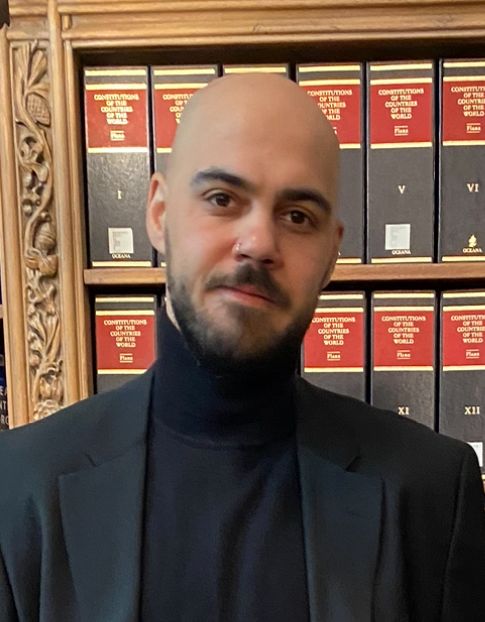
KRISTOF SZITAR is a researcher and translator of Urdu and Persianate literatures, currently completing his PhD at the University of Lausanne, where he studies Persian poetry of the Ghaznavid period and its multilingual afterlife across South and Central Asia, the Iranian plateau, and the Caucasus. He previously served as Visiting Assistant in Research at Yale University, and in 2024 was the Urdu preceptor at Heidelberg University’s Summer Program.
At the heart of his work is Urdu as a cosmopolitan literary language shaped by Persian, Arabic, Turkic, and Indic traditions. He is especially interested in how Urdu grows out of the wider Persianate and Turkic literary worlds—through figures such as Amīr Khusraw and Amīr ʿAlī Shīr Navāʾī—and how it is later transformed by poets like Mīrzā Ghālib. In both teaching and translation, he approaches Urdu as a living archive of cultural encounter.