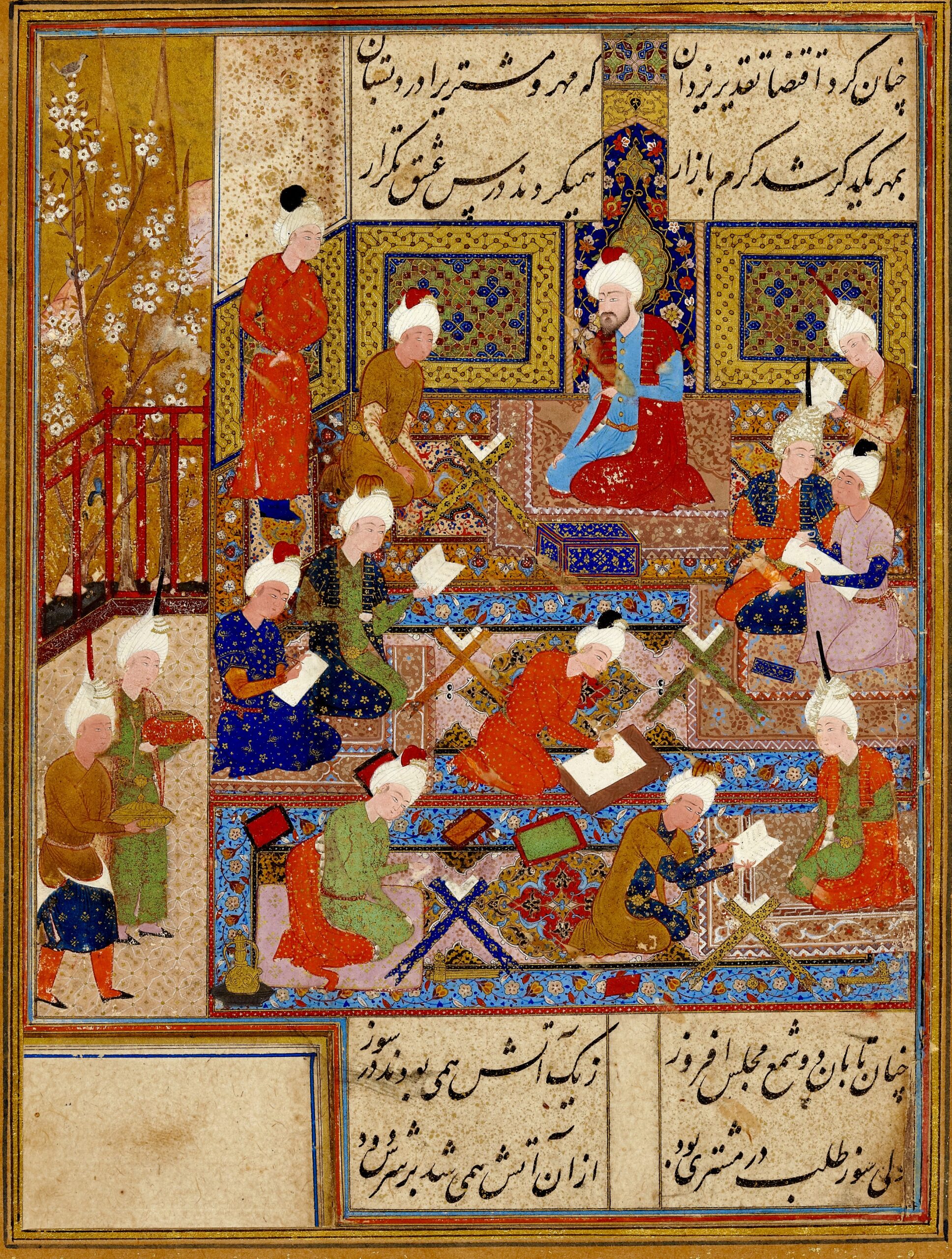
Thus Spoke Ferdowsi

A Complete Beginner's Introduction to Classical Persian

January 27 - March 24, 2027

Online, Weekly

Instructor: Ruben S. Nikoghosyan
Languages: English
Duration: 9 weeks (27 hours of instruction)
Frequency: 1 class per week (Wednesdays)
Duration of a Session: 3 hours (with a 20min break)
Deadline for Applications: December 30

Classes Start:  January 27 (6:00pm Yerevan Time)

Location: Online (Zoom)
Requirement: Knowledge of Arabic script by the start of the course. (contact for consultation)

Participation Fee: 450 USD

Registration: To apply, please click the “Apply” button above. Complete all required fields and submit. Accepted applicants will receive further instructions on participation.

Payment Method: Bank Transfer, Paypal

Note: All materials will be provided by the instructor

Background Image: A fragment of a painting from Anṣārī’s Tomb entrance chamber.

Second Image: A scene from ‘Aṣṣār-i Tabrīzī’s masnavi “Mihr-u Muštarī”. Inventory number: 78/2006. © The David’s Collection, Copenhagen, Denmark. Photo: Pernille Klemp. The courtesy of Navid Mollaaghaei.

A scene from 'Aṣṣār-i Tabrīzī's masnavi "Mihr-u Muštarī" © The David's Collection, Copenhagen, Denmark.

Introduction

As the title suggests, this course is a complete beginner’s introduction to Classical Persian, designed for everyone interested in learning this wonderful language and gaining access to its rich literary heritage, which may seem hidden behind seven walls to those unfamiliar with Persian.

The course will begin with a basic introduction to Classical Persian grammar and will gradually, step by step, build towards a better understanding of the language, its grammar, morphology, phonetics, and stylistics.

By the end of the course, you will be able to access and read intermediate-level texts (I would include Bal’amī’s History, Hudūd al-‘Ālam, Tarsūsī’s Dārābnāma, Mujmal al-Tawārīkh, Sa’dī’s Gulistān, and many others in this category) independently, with the help of a dictionary. Moreover, provided that you complete all the homework assignments, you may even be able to venture into more challenging texts, both in prose and verse.

Course Outline

The classes will meet once a week, on Wednesdays at 6:30 PM Yerevan time, and will last three hours. Each class will be divided into two sections, with a 20-minute break in between.

On the first day, I will give a brief introduction to Classical Persian, its geographical and historical position, and some linguistic background on the development of the language. We will also take an initial look at the main features of Classical Persian grammar, an overview of which we will continue in the second class. The second class will serve as the main preparation for beginning our work with the texts.

The course will be focused primarily on a practical approach to learning. We will therefore be working with authentic texts from the very beginning. Our first readings will include Balʿamī’s translation of al-Ṭabarī, a historical text that is particularly well suited to our purposes. We will also look at Ṭarsūsī’s Dārābnāma, a more epic narrative belonging to a somewhat later period.

As for poetic texts, we will read a selection of quatrains by Khayyam, alongside passages from other Persian poets. Finally, we will turn to Saʿdī’s Gulistān, from which we will read a number of selected passages.

A considerable part of the course will be devoted to homework assignments. These will play an essential role in your progress, and I strongly encourage you to complete them regularly. Provided that you do the assigned work, you should be able to make substantial progress over the relatively short duration of the course.

Course Objectives

The main objective of the course is to bring participants to an intermediate level of reading proficiency in Classical Persian and enable them to work analytically with Classical Persian texts.

By the end of the course, provided that you attend the classes regularly and complete all the assigned homework, you will:


  1. Gain a firm and solid grasp of Classical Persian grammar.

  2. Acquire a vocabulary of approximately 800–1,000 lexical items, with the possibility of learning even more.

  3. Develop the ability to analyse sentence structures and understand the grammatical relationships between different elements of a Classical Persian sentence.

  4. Become familiar with some of the major literary works and authors of Classical Persian literature.

  5. Learn to use the main reference tools, resources, and scholarly editions available for working with Classical Persian texts.

  6. Acquire the necessary knowledge and practical skills to continue your studies independently.

Key Points to Know

There are a few important things I would like you to keep in mind before enrolling in the course. 


1. Learning Classical Persian in a relatively short period of time

The first thing to note is that it is indeed possible to acquire a certain level of proficiency in Classical Persian within a relatively short period of time. Persian grammar, in general, is not an overly complicated subject, provided that it is taught in a methodical and concise manner, without overwhelming the learner with unnecessary information.

Another important point is that, although the vocabulary can sometimes pose challenges, depending on the text and the edition you are working with, knowing which materials to use and having the right strategy for approaching a text can make a considerable difference. With the right approach, even a fairly basic knowledge of grammar can allow you to analyse and understand texts.


2. Knowledge of the Arabic script

The course will proceed on the assumption that participants have at least a basic knowledge of the Arabic script. Learning the alphabet is largely a matter of practice and familiarisation, and I believe that even if you have no prior knowledge of it, you can acquire a sufficient level of familiarity within the two months preceding the beginning of the course.

Nevertheless, we will cover the phonetics and the sounds represented by individual letters as part of our studies. So, even if you already know the Arabic script but are not entirely familiar with the sounds of the individual letters in Persian, there is no need to worry.

In any case, if you are unsure whether your knowledge of the Arabic script is sufficient, or if you have any questions, you are always welcome to contact the school and ask for clarification.


3. Classical Persian pronunciation

One final point worth emphasising is that we will study Classical Persian using its historical pronunciation. Classical Persian pronunciation differs in certain respects from that of modern Iranian Persian, particularly when it comes to the pronunciation of some vowels.

Our goal is therefore not specifically to learn the pronunciation of modern Iranian Persian, but rather to become familiar with the historical pronunciation of Classical Persian and to be able to read texts accordingly.

These are the main points I wanted to bring to your attention. As always, please feel free to contact me if you have any questions or concerns about the course. I will be happy to clarify anything you might be unsure about.

Testimonials

I have taken both Shahnameh and Classical Persian Prose reading courses with Ruben, and all I can say is that he is the best language teacher I have had the pleasure of learning with. He has an extraordinary ability of introducing a wide range of topics like philology, history, and geography into his language teaching, and his encylopaedic knowledge of the Iranian world (and its languages) creates a learning experience that I can confidently say is unique to him and his school.
Rohan Kaya
Faculty of Asian and Middle Eastern Studies, University of Oxford
Ruben was beyond exceptional as a tutor in Classical Persian, custom-designing and adapting to my interests and progress an invigorating course in its medieval historiography. He made every lesson enjoyable, and never failed to amaze with his encyclopedic knowledge of the Persian language, illuminating roots and derivations of any given word through the ages. Simply put, I could not have asked for a more inspiring and excellent teacher!
Alexander Sherborne
DPhil Student, Magdalen College, University of Oxford
Ruben’s Persian reading class was an enriching and eye-opening experience. Ruben is incredibly patient, resourceful, and knowledgeable, guiding us through the nuances of Persian texts and manuscripts with clarity and enthusiasm. Beyond the reading exercises, Ruben provided invaluable recommendations for Persian language resources, encouraging us to expand our studies and helping out with the primary sources of my research on Central Asian history. Enjoyed so much reading Persian prose with Ruben and learning about histories!
Yue Xie
PhD student, Department of History of Art & Architecture, Harvard, USA
This was the second course that I have taken with Ruben and I cannot recommend studying with him highly enough! He is an incredibly engaging teacher who really makes the course material come to life. I have studied Persian for many years but my courses with Ruben have been on a whole other level. I love his method of using classical texts to teach Persian. It is so rewarding to complete a course feeling both the satisfaction of having learned to better understand the language and also the pleasure of having read another major classic of Persian literature. Not only did I learn a lot during these two courses, I also had a lot of fun! Ruben was always available to clarify questions about grammar and vocabulary and was very responsive to questions that I sent him between classes. I especially appreciated how he used his deep knowledge of Middle Persian to explain questions that came up about the numerous peculiarities of early classical Persian. After taking these two courses with Ruben, I've noticed a significant improvement in my ability to grasp the subtleties of classical Persian texts, nuances that previously eluded me. I sincerely appreciate his exceptional courses; they have renewed my love for classical Persian literature.
Ali Hassan
Ali Hassan
Department of South and Southeast Asian Studies, University of California, Berkeley, USA
Learning Persian literature with Ruben was a fantastic experience. I started learning Persian out of necessity, but thanks to Ruben, I began to understand the beauty of its language and literature, and now I am enjoying learning Persian. I took the Classical Persian course and Shahnameh course, which allowed me to understand the necessary grammar and sentence structures to read classical Persian literature. Most of all, Ruben did his best to enhance my reading ability by letting me read and translate each line of Persian text by myself. I first thought my Persian skills were not good enough to read those texts and stumbled a lot when I read them, but Ruben always waited until I made enough effort to think about the text and then gave a practical guideline based on my level. I think learning Persian literature with Ruben also helped my overall Persian skills, as he introduced a lot of words and expressions (both classical and modern) and made me listen to colloquial and literary Persian. Learning Persian literature can be one of the best ways to understand the Iranian and Persianate culture's profound historical heritage, about which Ruben offers insightful explanations and perspectives.
So Jeong Lee
MA Student in Art History, Seoul National University, South Korea

FOLLOW US

CONTACT
Ruben S. Nikoghosyan (Yerevan, Armenia)

Email: nikoghosyanruben@gmail.com