8 Must-Know Digital Projects in Iranian and Central Asian Studies
by Ruben S. Nikoghosyan
Have you ever come across a webpage or a project and wished that you knew about it before? How nice would it have been, right?
It has happened to me many times, in fact so many, that it would be hard to recall all the instances. Sometimes a simple recommendation by a friend or colleague, has saved me a lot of time, or has opened new prospects.
This is the goal of the current list, which is very modest at the moment, but will be expanding as the time goes on. Here you will find ongoing projects in the domain of Iranian, Central Asian and Silk Road Studies, that dedicated people have created and contributed to.
I have not included the projects commonly known, such as Enciclopaedia Iranica, or Ganjoor.
Here is an overview of the list:
- Invisible East
- International Dunhuang Programme
- Pārsīg Database
- Zoroastrian Middle Persian Digital Corpus and Dictionary (MPCD)
- Silk Road Virtual Museum
- TITUS: Thesaurus Indogermanischer Text- und Sprachmaterialien
- Sasanika: Late Antique Near East Project
- Turfanforschung: Digitales Turfan-Archiv
I would greatly appreciate if you write me your suggestions. Please write me by the following e-mail address: nikoghosyanruben@gmail.com
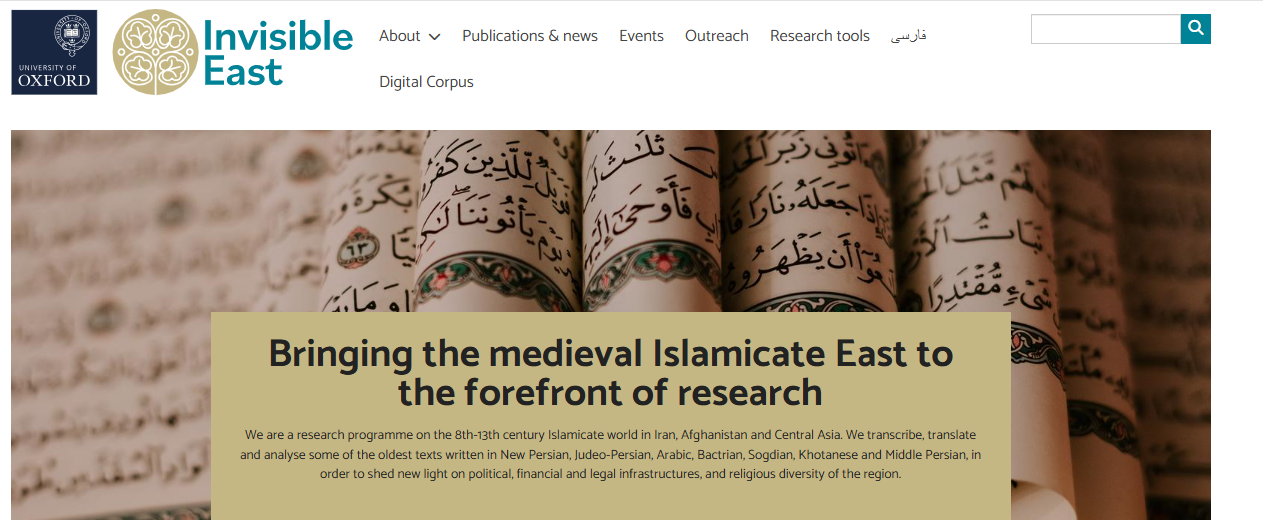
Main Website: https://invisibleeast.web.ox.ac.uk/
Invisible East Digital Corpus*: https://www.invisible-east.org/
Location/Institution: Oxford
Launch: 2020
Subject: Medieval Islamicate East; manuscripts, documents, digitization; Persian, Arabic, Early Judeo-Persian, Bactrian, Sogdian, Khotanese, Middle Persian; Iran, Afghanistan, Central Asia, Xinjiang.
Project Director: Arezou Azad
Team:
- Michael Allaway – Digital Humanities Consultant
- Mateen Arghandehpour – Digitisation Officer
- Pejman Firoozbakhsh – Research Associate
- Ofir Haim – External Advisor
- Hugh Kennedy – AHRC Co-investigator
- Nabi Saqee – Bodleian Libraries Afghan Visiting Fellow
- Edward Shawe-Taylor – Assistant Database Manager
- Hayley Smith – Programme Co-ordinator
- Nadia Vidro – Editorial Fellow
* You can find the digital corpus of the manuscripts along with their transcriptions and translation on this website.
Summary:
Invisible East is a research programme based at Oxford University and led by Arezou Azad, dedicated to uncovering and making accessible the rich documentary heritage of the Eastern Islamicate world (Iran, Afghanistan, and Central Asia) from the 8th to 13th centuries. The project focuses on the transcription, translation, and analysis of some of the oldest surviving texts written in New Persian, Judeo-Persian, Arabic, Bactrian, Sogdian, Khotanese, and Middle Persian. By digitizing these recently discovered documents (many previously unknown to the broader public), Invisible East sheds new light on the region’s political, financial, and legal infrastructures, as well as its remarkable religious and cultural diversity.
In addition to its core scholarly work, the Invisible East website hosts curated content aimed at wider audiences. The “Document of the Month” series, edited by Nadia Vidro, highlights some of the interesting medieval documents unearthed and studied by Invisible East researchers and their global collaborators. The “Blogs” section features a variety of captivating posts that explore the written and cultural heritage of the Islamicate East, making the project’s findings engaging and accessible to both academic and general readers.
Overall, Invisible East is an incredibly important resource for anyone interested in the political, cultural and literary history of the Medieval Islamicate East.
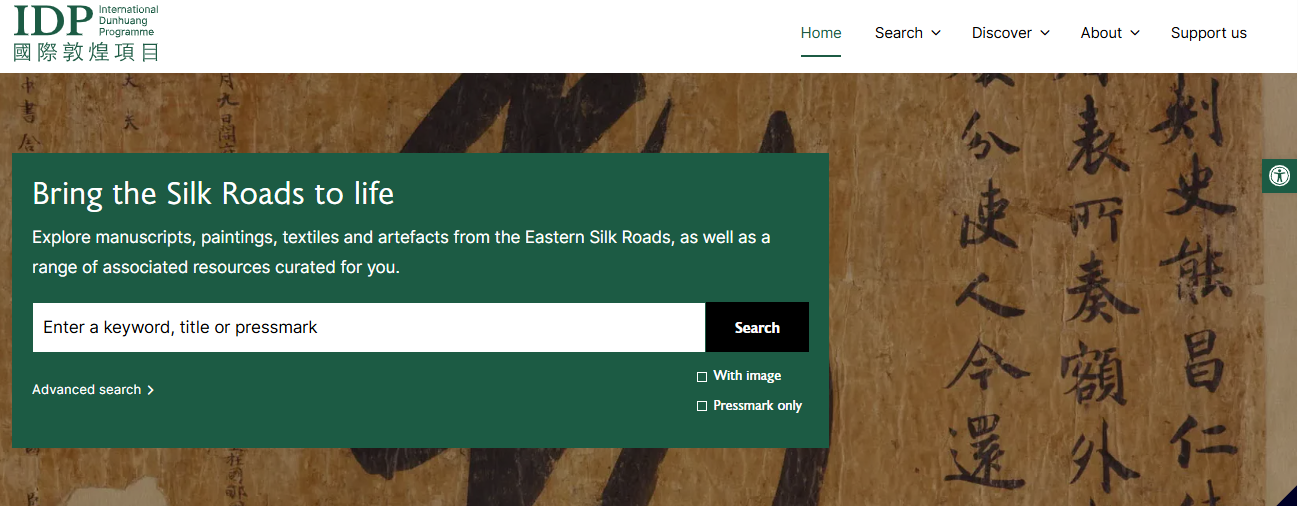
Main Website: https://idp.bl.uk/
Directorate: British Library (London)
Founding Institutions: British Library (London); National Library of China (Beijing); The Institute of Oriental Studies (St Petersburg); Ryukoku University (Kyoto); Berlin-Brandenburgische Akademie der Wissenschafter (Berlin); Dunhuang Academy (Dunhuang); Bibliothèque Nationale de France (Paris).
See the list of the Contributing Partners here*
Launch: 1994
Subject: Silk Road Studies; Silk Road documents; digitization; history of Silk Roads exploration; material and cultural history of the Silk Roads.
Project Leader: –
Team: –
Summary:
The International Dunhuang Program, originally known as the International Dunhuang Project, is a pioneering international collaborative effort led by the British Library and founded in 1994. Its main aim is to catalogue, digitize, and conserve a vast collection of manuscripts, printed texts, paintings, textiles, and other artifacts discovered in the Mogao Cave (cave no. 17) of Dunhuang, as well as related Silk Road sites. By bringing together partner institutions from around the world, the program makes these collections freely accessible online, allowing researchers, students, and the public to explore and study them without endangering the fragile originals.
Over the years, the program has also organized numerous research projects, exhibitions, and educational initiatives that highlight the cultural and historical significance of the Silk Roads. The first director, Susan Whitfield, a leading scholar in the field, guided the program until her retirement in 2017.
With its founding institutions based in London, St Petersburg, Beijing, Paris, Berlin, Dunhuang, the International Dunhuang Program continues to be an essential resource for scholars, students, and anyone interested in the shared cultural heritage of the Silk Roads and the history of exchange across Asia.
Thanks to the search engine on the IDP website it is possible to search among thousands of manuscripts, photographs and documents.
You can also explore various collections based on the archaeological site, material, collection, and institution, by following the link here.
Besides exploring the collections, you can also check the IDP blog, which has numerous interesting posts that help us understand the history of the collections, the ongoing research on them and other related topics. For example, you can check this post by Michael Erdman on the Old Turkic omen-book known as Irk Bitig, or learn about the scribal practices in Dunhuang in this post by Sam van Schaik.
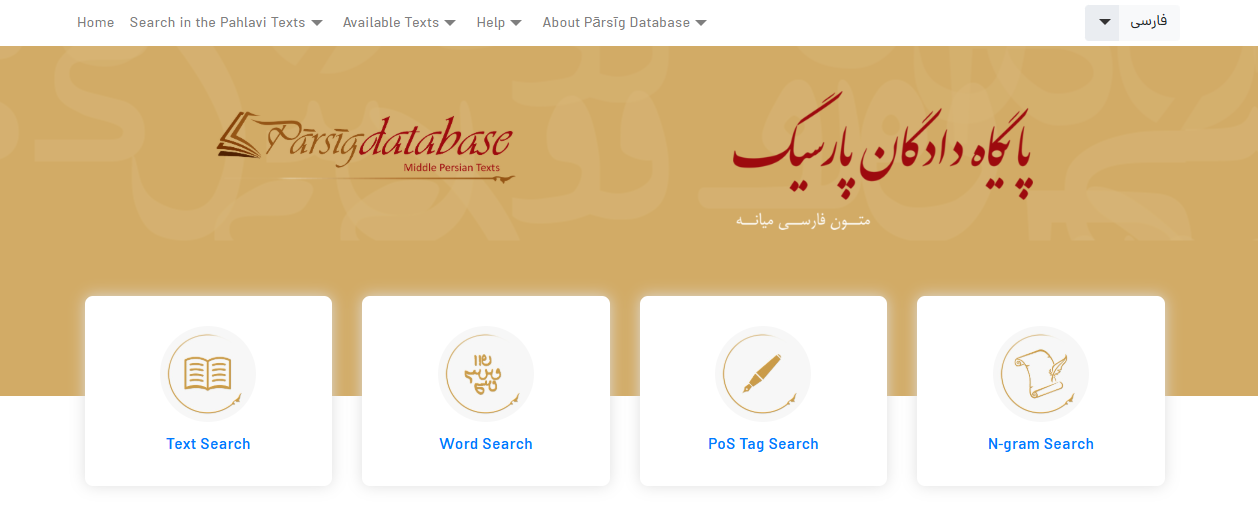
Main Website: https://www.parsigdatabase.com/
Location/Institution: Tehran
Launch: December 2020
Subject: Middle Persian Texts; Zoroastrian Texts; Pahlavi; Zand; Lexicography
Project Leader: Farzaneh Gostasb
Team:
- Nadia Hajipour, PhD in Ancient Iranian Languages and Culture, Researcher at IHCS.
- Cyrus Nasrollahzadeh, PhD in Ancient Iranian Languages and Culture, Associate Professor at IHCS.
- Sho’leh Hesarpouladi, PhD candidate in Ancient Iranian Languages and Culture, Tehran university.
- Hossein Mostafavi, PhD in Ancient Iranian Languages and Culture.
Summary:
Pārsīg Database is a private project launched in December 2020, dedicated to making the Middle Persian texts available to students and the general public. It offers easy access to original texts, providing alongside their transcriptions, transliterations, and translations, with both Persian and English interfaces. The project also has a useful dictionary, which students studying Middle Persian can easily use for their studies.
It is based in Tehran and directed by Farzaneh Goshtasp, a leading scholar on Middle Persian and Zoroastrian studies in Iran.
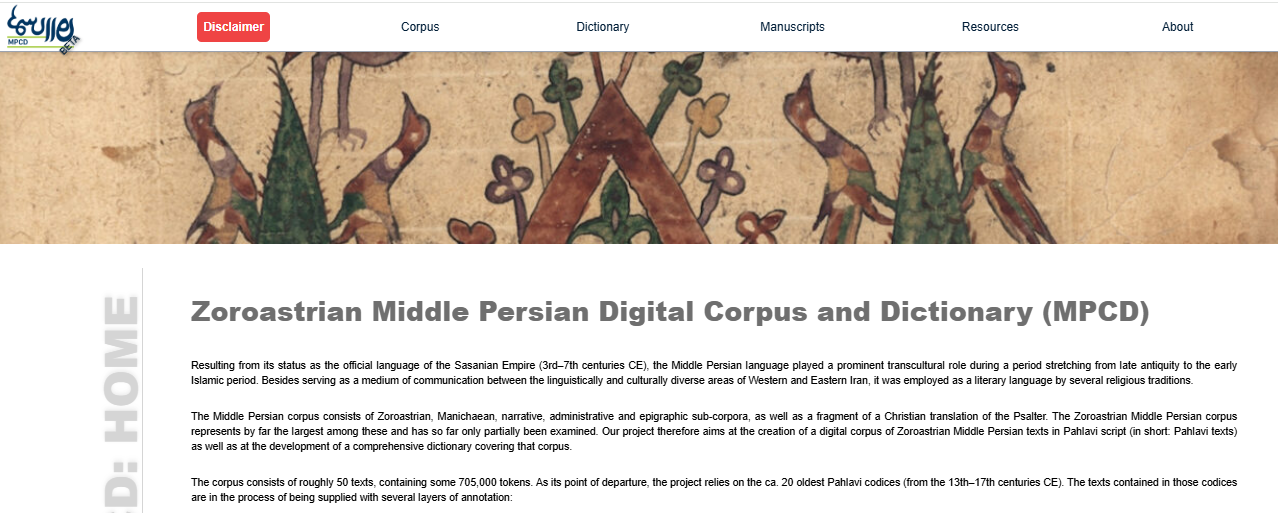
Main Website: https://www.mpcorpus.org/
Location/Institution: Ruhr-University Bochum; Freie Universität Berlin; University of Cologne
Funded by: DFG
Launch: 2021
Subject: Middle Persian Corpus; Pahlavi; Lexicography
Project Leaders: Kianoosh Rezania; Alberto Cantera; Øyvind Eide
Team:
Ruhr University Bochum
Principal Investigator
- Kianoosh Rezania (kianoosh.rezania@rub.de)
Research Associates
- Iris Colditz (iris.colditz@rub.de)
- Thomas Jügel (thomas.juegel@rub.de)
- Slavomír Čéplö (bulbul@bulbul.sk)
- Fatemeh S. Musavi (seyyedehfatemeh.musavi@rub.de)
Student Assistants
- Anahita Shamsaei (anahita.shamsai@gmail.com)
- Narges Eskandarnia (narjes_eskandarnia@yahoo.com)
- Allegra Goldstrass (allegra.goldstrass@rub.de)
- Alonso Constenla Cervantes (alonso.constenlacervantes@rub.de)
- Reyhaneh Lamei (reyhaneh.lamei@rub.de)
Freie Universität Berlin
Principal Investigator
- Alberto Cantera (alberto.cantera@fu-berlin.de)
Research Associates
- Benedikt Peschl (benedikt.peschl@fu-berlin.de)
- Arash Zeini (active until February 2022)
Student Assistants
- William Uyttendaele (williau97@zedat.fu-berlin.de)
- Nikta Yekrang Safakar (niktay00@zedat.fu-berlin.de)
University of Cologne
Principal Investigators
- Øyvind Eide (oeide@uni-koeln.de)
- Claes Neuefeind (c.neuefeind@uni-koeln.de)
Research Associates
- Moritz Esser (moritz.esser@uni-koeln.de)
- Francisco Mondaca (active until May 2024)
Student / Research Assistants
- Malte Rudius (m.rudius@uni-koeln.de)
- Luke Maximilian Günther (active until April 2024)
Summary:
The project focuses on Zoroastrian Middle Persian texts (Pahlavi script), building a digital corpus and a comprehensive dictionary. The corpus includes roughly 50 texts (≈705,000 tokens), primarily based on the 20 oldest Pahlavi codices (13th–17th c.).
The work on the website is still in progress, so not all the features are available yet. It is divided into 4 main sections:
- Corpus
- Dictionary
- Manuscripts
- Resources
From this, the Manuscript section is still not properly available. However, the Corpus itself works well and makes many important MP texts (including Denkard, Bundahišn, etc.) easily accessible to all.
Texts are being annotated across several layers:
- Orthographical and phonographical (transliteration and transcription)
- Grammatical (morpho-syntactic)
- Semantic (semasiological and onomasiological)
- Intertextual (linking Zand texts to their Avestan originals)
The project aims to expand to other Middle Persian sub-corpora and other Middle Iranian languages, eventually producing a complete dictionary of Middle Persian. It is a collaboration between Ruhr-University Bochum, Freie Universität Berlin, and University of Cologne, funded by the DFG as a long-term project (2021–2030).
Main Website: https://silkroadvirtualmuseum.com/
Location/Institution: International Institute for Asian Studies, Leiden
Launch: 2025
Subject: Silk Road; Silk Road History; Material Culture: Virtual Museums
Project directed by: VirtualMuseum360
Project Leader: Richard T. Griffiths
Team: –
Summary:
The Silk Road Virtual Museum is an online platform that brings to life the art, culture, and history of cities along the historic Silk Roads from Late Antiquity to the year 1450 AD. Developed by Leiden University and VirtualMuseum360, it allows users to explore curated virtual exhibitions in a 360° environment, with multilingual audio guides and scholarly resources. The project aims to highlight cultural exchange, challenge stereotypes, and inspire further engagement with the Silk Road’s rich heritage.
The website’s main page presents sections dedicated to various geographical areas, historical periods, and topics. Currently there are exhibitions dedicated to:
- Afterlives Along the Silk Road
- Byzantium (1262-1453)
- Byzantium 5th-10th Centuries
- Caravanserai (0-1500)
- Chess Along The Silk Road
- Cilicia (1226-1375)
- Early Ming Dynasty China (1368-1450)
- Golden Horde
- Heavenly Horses
- Khitan Empire (907-1115CE)
- Khotan Kingdom
- The Mamluk Sultanate
- Northern Song and Yuan Dynasty Art
- Sasanian Empire (224-651)
- Seljuk Empire
- Silk Along the Silk Road
- Map Room 700-1500 CE
- Sogdians: Silk Road Traders
- Taiyuan Tombs
- Tang Dynasty China
- The Timurid Empire (1370-1507): The Court
- Tibetan Empire (618-842)
- Umayyad and Abbasid Caliphates (656-1000)
- Venice (1261-1450)
- Vikings in the East
Main Website: https://titus.uni-frankfurt.de/
Location/Institution: Goethe-Universität Frankfurt am Main, Institut für Empirische Sprachwissenschaft
Launch: 1987 (officially established under the name TITUS in 1994)
Subject: Comparative Indo-European linguistics; digitization, encoding, and analysis of ancient Indo-European texts and languages
Project Leader: Jost Gippert
Team: International collaboration of scholars and institutions specializing in Indo-European philology and computational linguistics (including universities in Frankfurt, Vienna, Leiden, Prague, and Copenhagen).
Summary:
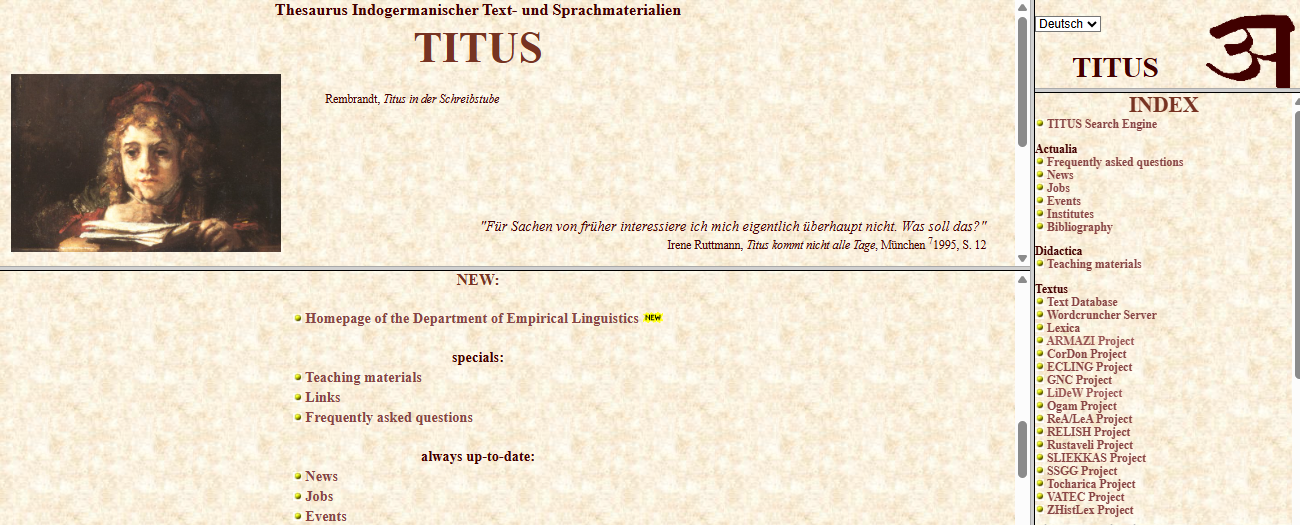
The Thesaurus Indogermanischer Text- und Sprachmaterialien (TITUS) is a long-term international research project dedicated to digitizing, encoding, and providing access to ancient texts written in Indo-European languages for linguistic and philological study.
Originating from discussions at the 1987 Leiden Indo-European Congress and officially launched in 1994 under the direction of Jost Gippert at the University of Frankfurt, TITUS has created an electronic corpus of texts in Sanskrit, Greek, Latin, Hittite, Old High German, as well as such Iranian languages as Avestan, Middle Persian, Old Persian, Sogdian, Bactrian, Khotanese, Parthian, etc. Beyond simple digitization, the project focuses on accurate encoding of scripts, morphological tagging, and analytical tools for comparative linguistic research.
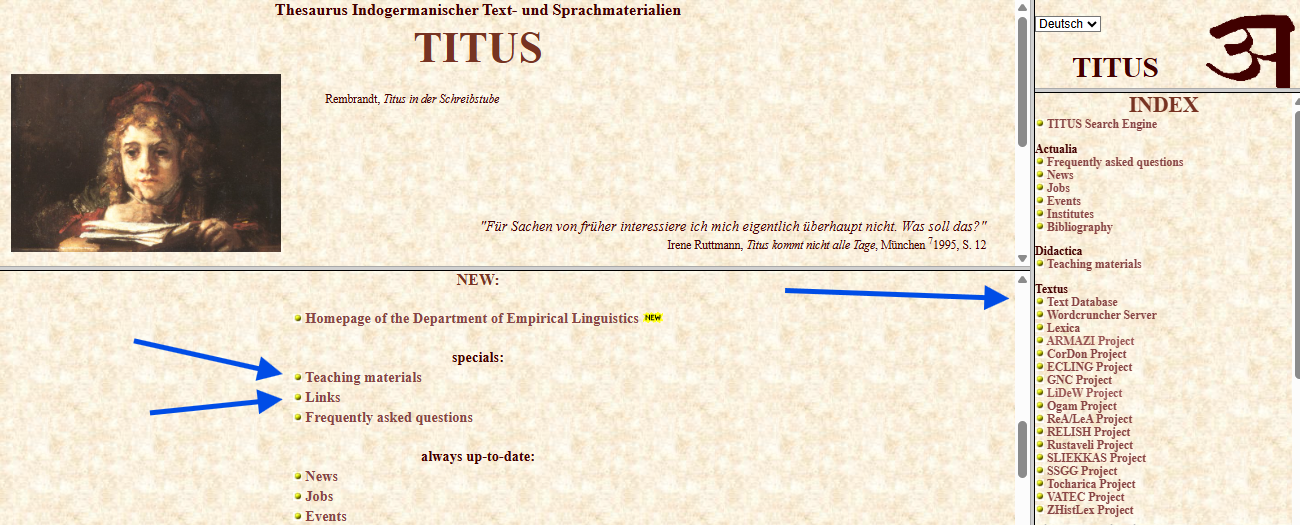
Besides the text corpus, the website provides a wealth of highly useful links, which otherwise are extremely difficult to find. Here are some of those links:
- Digital Archive of Toyo Bunko Rare Books
- Digital Silk Road Project
- The Perry-Castañeda Library (PCL) Map Collection
Main Website: https://sites.uci.edu/sasanika/
Location/Institution: UC Irvine
Launch: –
Subject: history of the Sasanian Empire; Sasanian inscriptions; archaeology.
Project Director: Touraj Daryaee
Project Manager: Layah Ziaii-Bigdeli
Summary:
As stated in the About Us section of the website:
“Sasanika is dedicated to the promotion of research and study on the history of the Sasanian dynasty. Its mission is to facilitate direct and free access to primary information. This period of Iranian history and culture encompasses a vast geographical region that goes beyond the territorial bounds of modern-day Iran and most of the former archaeological work was completed by the German, French, Italians and Russian excavators with only the recent archaeological work done in Farsi and English. As a result, the information has been published in various languages and often in old and out of print publications. Given the geographic diversity of this material, the implementation and use of the English language would aid in providing accessibility to a greater number of audience and surpassing the barrier of multilingualism to facilitate greater access to many academic scholars, university students and public users.”
The Sasanika website is a small yet very useful source for the students of Sasanian history, as among everything else, it provides access to many Sasanian royal and private inscriptions, providing the transliteration, transcription, and translation of most of the known texts. You can access the material here.
The website also contains the issues of the open access journal E-Sasanika, where you can find many useful and interesting titles. A list of Iranian journals on history and archaeology is available here.
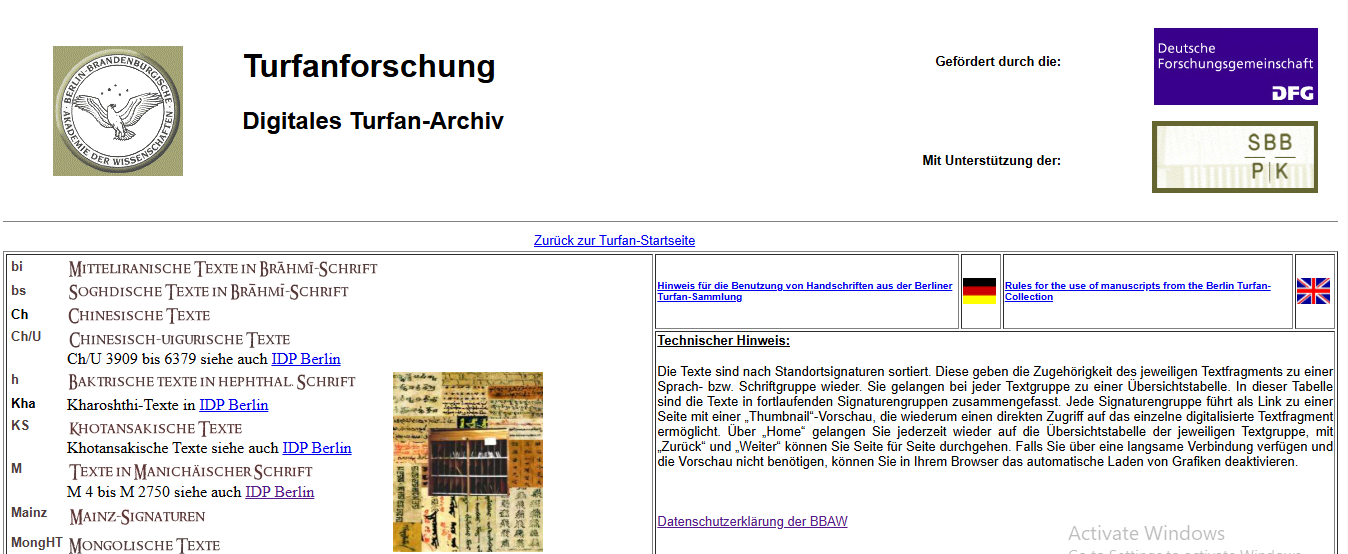
Main Website: https://turfan.bbaw.de/
Turfanarchiv: https://turfan.bbaw.de/dta/
Location/Institution: Berlin-Brandenburgische Akademie der Wissenschaften
Launch: 1997
Subject: The project is dedicated to the scientific editing, cataloguing, digitisation, and interpretation of the Turfan manuscript collection of Buddhist, Manichaean, Christian and secular texts, documents of monastic and commercial life in Old Turkic (in Brāhmī, Manichaean and Uighur script), Sogdian, Uighur, Nestorian, Khotan Saka, Tumshuq Saka, Middle Iranian languages (Middle Persian, Parthian), Chinese, Tibetan, Syriac, Sanskrit/Prakrit, Tocharian A/B, Mongolian (Uighur-Mongolian script), Xixia, Manchurian.
Project Leader: Melanie Malzahn
Team:
Head of Research Office
Abdurishid Yakup
Research Staff
Ayşe Kılıç Cengiz
Alisher Begmatov
Peter Zieme (Senior Researcher)
Desmond Durkin-Meisterernst
Scientific-Technical Staff
Susann Rabuske
Research Staff for the Cataloguing of Oriental Manuscripts in Germany (AdW Göttingen)
Simone-Christiane Raschmann
Christiane Reck
Summary:
The Turfanforschung project at the Berlin-Brandenburgische Akademie der Wissenschaften is one of the world’s foremost efforts to make accessible, edit and research the large manuscript corpus excavated at the Turfan oasis in Xinjiang, China. The collection comprises around 40.000 fragments recovered by four German expeditions in the early 20th century, spanning the 2nd to the 14th centuries, and including Buddhist sutras and commentaries, Christian and Manichaean texts, secular monastic and economic documents, written in more than twenty languages (Old Uyghur, Chinese, Iranian languages, Tocharian, Sogdian, Old Turkish runes etc.).
The project’s main tasks are: the philological editing of the Iranian and Turkish (Old Uyghur, Manichaean) parts of the collection; the comprehensive digitisation and archival preservation of the originals (completed for major parts); cataloguing and metadata work; integration into the IDP database; and fostering international collaboration.
Because many of the texts are very fragmentary, written in languages or scripts poorly studied when first discovered, and encompass religious, literary, linguistic and economic dimensions, the project holds immense importance for Central Asian studies, comparative religion, philology and Silk Road history.
You might also enjoy checking their publications here.