January 12 - March 2, 2027
Online, Weekly
Instructor: Iskandar Ding
Language of Instruction: English
Duration: 8 weeks (16 hours)
Frequency: 1 class per week (Tuesday)
Duration of a Session: 2 hours (with a 15min break)
Deadline for Applications: December 20
Classes Start: January 5 (9:00pm Yerevan Time)
Location: Online (Zoom)
Requirement: None
Participation Fee: 380 USD
Registration: To apply, please click the “Apply” button above. Complete all required fields and submit. Accepted applicants will receive further instructions on participation.
Payment Method: Bank Transfer, Paypal
Note: All materials will be provided by the instructor
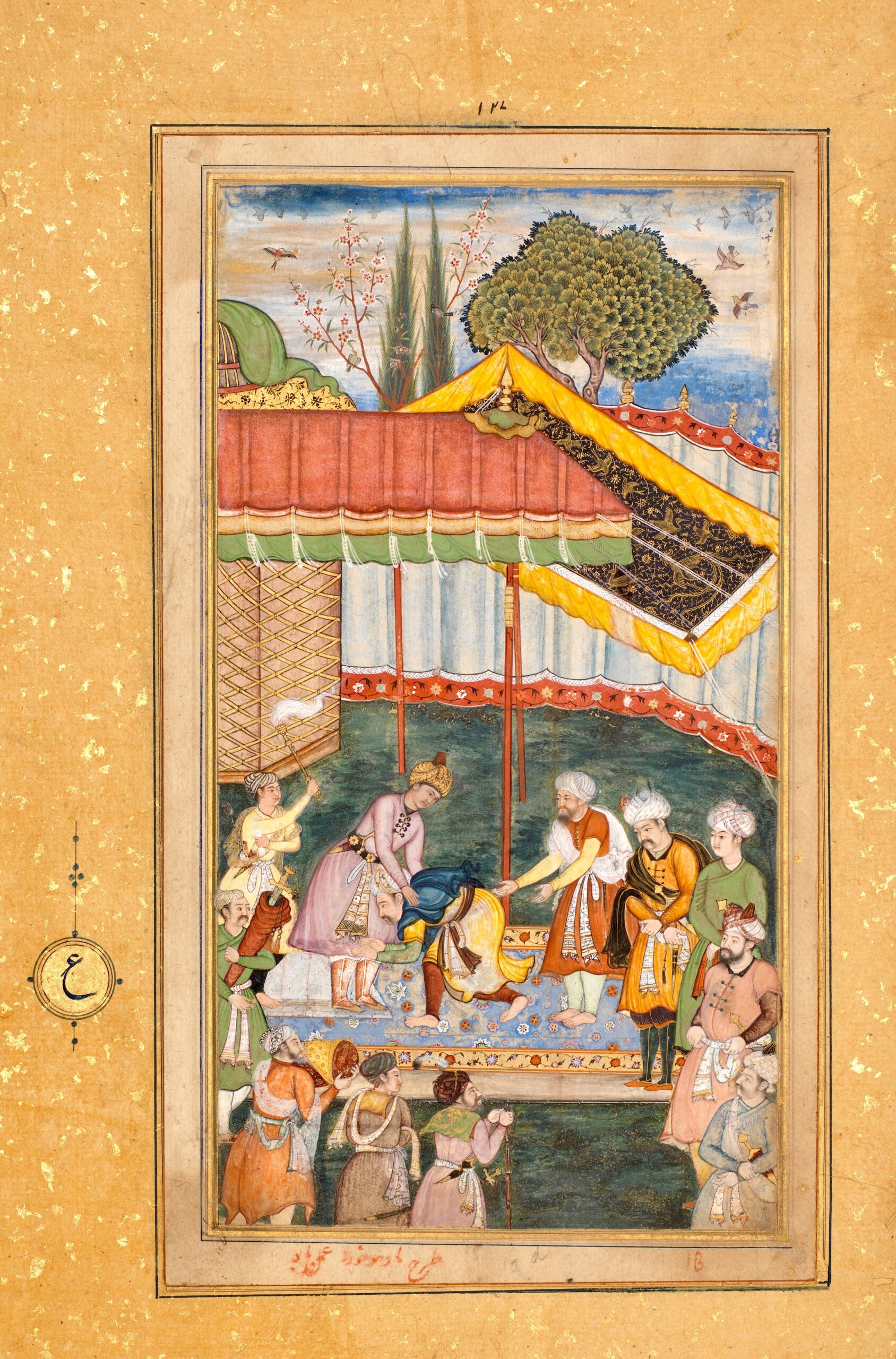
A page from the Babūrnāma: "Emperor Babur Receiving a Visitor". ca 1590. © Metropolitan Museum of Art, NY
Introduction
Chaghatay, or simply Turkī, was an important classical literary language of much of the eastern Islamic Perso-Turkic world, flourishing particularly in Central Asia from the 15th century onwards. It served as an important vehicle for poetry, prose, historiography, and religious literature, and formed an integral part of the wider Persianate literary tradition.
Alongside Classical Persian, Chagatai was one of the two principal literary languages of Central Asia, in which an extensive body of literary, historical, and scholarly works was produced from the 15th century onwards. By acquiring a good command of both languages, you will gain access to a substantial portion of Central Asia’s late medieval and early modern textual heritage.
Course Description
This beginner-level, eight-week course introduces participants to the fundamentals of Chaghatay grammar and guides them through selected works of classical Turkic literature from Central Asia. The first two weeks focus on essential grammatical structures, while the remaining six weeks are devoted to close readings of poetry and prose from pre-classical, classical, and post-classical periods.
Throughout the course, particular attention will be paid to the interaction between Turkic and Persian literary traditions. Texts will be studied in the original Perso-Arabic script alongside scholarly transliterations, with grammatical explanations and historical and literary commentary.
No prior knowledge of Chaghatay is required, although familiarity with Persian and/or a modern Turkic language will be helpful.
Class Structure
Classes will meet once a week, on Tuesdays at 9:00 PM Yerevan time. Each session will last approximately two hours, with a 15-minute break in between.
Each class will begin with a review of the homework assignment and the grammatical material covered in the previous session. Participants will then proceed to read and analyse the text assigned for that day. Questions and discussion will be welcome throughout the class.
Particular attention will be paid to the grammatical and literary structure of the texts, as well as to their vocabulary. In addition to working through the assigned readings, the instructor will introduce participants to the main philological and linguistic principles and methods involved in reading, interpreting, and analysing Chagatay texts.
Course Benefits
By completing the course, participants will:
Acquire a solid foundation in Chaghatay grammar and develop the ability to read and analyse Chaghatay texts independently with the help of dictionaries and other reference resources.
Become familiar with five major Chaghatay authors, three important literary works, and a selection of significant poetic compositions essential for understanding the Chaghatay literary tradition.
Acquire approximately 800–1,200 essential Turkī words, substantially facilitating further independent reading of Chaghatay texts and the study of other Turkic languages.
Develop an understanding of the grammatical structures of modern Uzbek and Uyghur, providing a valuable foundation for the further study of these languages.
Gain a deeper understanding of the interactions between Persianate and Turkic literary traditions and the wider influence of Persianate literary culture across Central Asia.
Develop the linguistic skills necessary to access Chaghatay historiographical sources, an essential resource for studying the history of Central Asia.
Gain access to the rich literary heritage of Xinjiang, including Chaghatay literary and printed works produced as late as the 19th and early 20th centuries.
Become familiar with the major genres, authors, and historical development of classical Turkic literature.
Weekly Program
Week 1 — Foundations of Chaghatay Grammar I: Nominal Morphology and Finite Verbal Forms
Introduction to the historical development of Chaghatay and its relationship with modern Turkic languages. Overview of phonology, Perso-Arabic orthography, transliteration, and basic Turkic syntax. Nominal inflection, including case endings, plurality, and possession; copular constructions; and the two basic finite verbal forms: the non-past and simple past.
Week 2 — Foundations of Chaghatay Grammar II: Non-finite Verb Forms and Deverbal Nominals
Introduction to non-finite verbal constructions, including participles, converbs, and verbal nouns. Particular attention to their role in clause linkage, subordination, and the formation of complex sentences. Introduction to verbal derivation and selected additional verbal forms necessary for reading literary Chaghatay.
Week 3 — Aḥmad Yasavī: Early Turkic Sufi Poetry
Introduction to Aḥmad Yasavī and the early Turkic Sufi literary tradition. Close reading of selected ḥikmats attributed to Yasavī, focusing on their relatively accessible language, devotional themes, and poetic structures.
Week 4 — ʿAlī Šēr Navāʾī: Sadd-i Iskandarī
Introduction to Navāʾī and the Timurid literary environment of Herat. Reading of selected sections from Sadd-i Iskandarī, Navāʾī’s Alexander romance.
Week 5 — ʿAlī Šēr Navāʾī: The Classical Chaghatay Ghazal
Close reading of selected ghazals by Navāʾī, introducing the conventions of classical Persianate lyric poetry, including poetic imagery, rhyme, refrain, and the ʿarūż metrical system. Discussion of the relationship between poetry and music, with examples of contemporary performances of Navāʾī’s ghazals in Central Asian musical traditions.
Week 6 — Bābā Raḥīm Mašrab: Mystical Love and Devotional Poetry
Close reading of selected poems exploring mystical love, longing, spiritual wandering, and religious devotion. Comparison with the earlier Yasavī tradition, with particular attention to continuities and developments in Turkic Sufi poetic expression.
Week 7 — Ẓahīr al-Dīn Muḥammad Bābur: Bāburnāma
Introduction to Bābur and his autobiographical memoir, the Bāburnāma. Close reading of selected passages illustrating Bābur’s personal experiences, observations, and literary style. Particular attention to narrative prose, complex syntactic constructions, and the interaction of Turkic and Persian in Bābur’s writing.
Week 8 — ʿAlī Šēr Navāʾī: Muḥākamat al-Luġatayn
Close reading of selected passages from Navāʾī’s celebrated comparison of Turkic and Persian. Examination of his arguments concerning the expressive capabilities, lexical richness, and literary potential of Turkic. Discussion of bilingualism, language prestige, and literary identity in the Timurid world, bringing together the linguistic and literary themes explored throughout the course.