Introduction to Classical Urdu Poetry:
From the Deccan to Delhi and Beyond
(17th–20th Centuries)
January 4 - February 22, 2027
Online, Weekly
Instructor: Kristof Szitar; Shubham Goswami
Languages: English, Urdu
Duration: 8 Weeks
Frequency: 1 class per week (Mondays)
Duration of a Session: 2 hours (with a 15min break)
Deadline for Applications: December 20
Classes Start: January 4 (9pm Yerevan Time)
Location: Online (Zoom)
Required level of Urdu: Intermediate (advanced reading course)
Participation Fee: 340 USD
Registration: To apply, please click the “Apply” button above. Complete all required fields and submit. Accepted applicants will receive further instructions on participation.
Payment Method: Bank Transfer, Paypal
Note: All materials will be provided by the instructor
Image Source: franpritchett.com
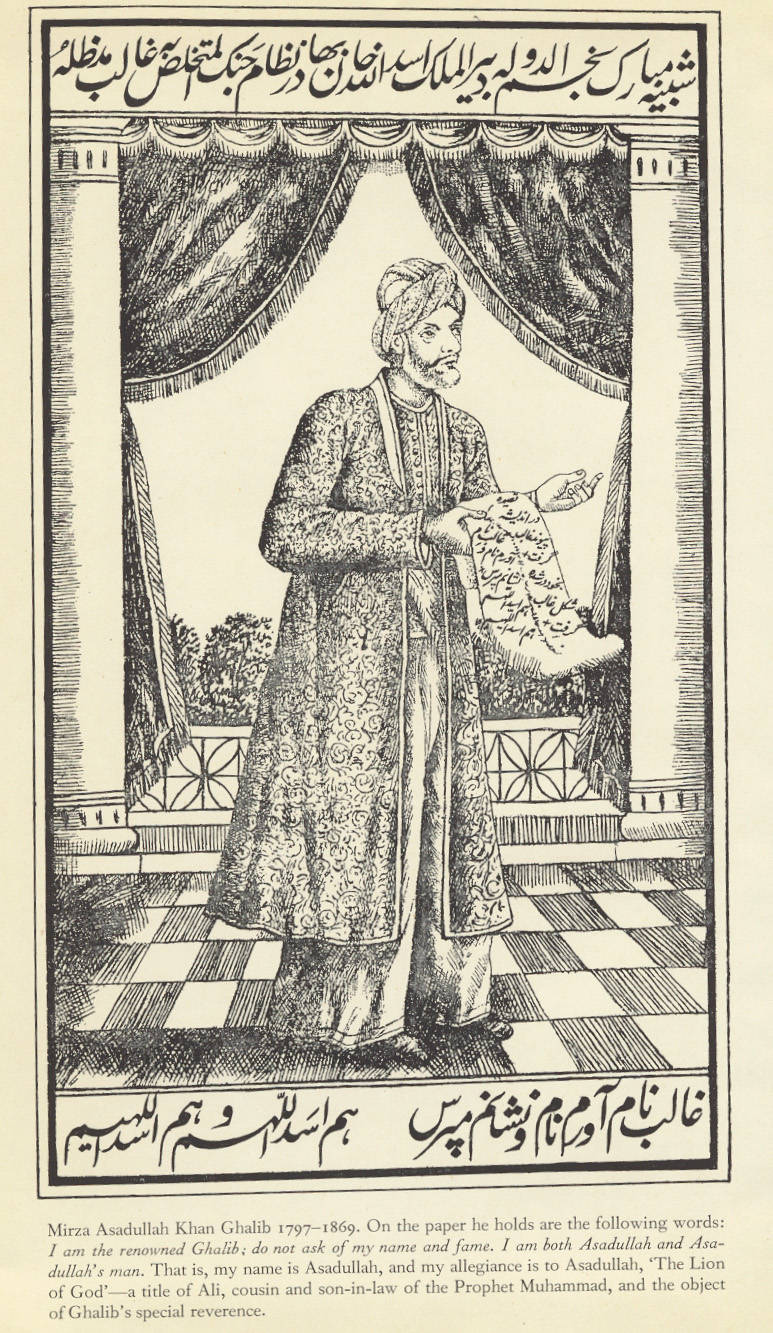
Lithograph of Mirza Ghālib, from his Kulliyāt, published by the Naval Kishore Press (1863)
Introduction
South Asia was not only a major center of Persianate culture in the early modern period but also the birthplace of one of its most productive and versatile literary languages: Urdu. Emerging from the multilingual literary cultures of the Deccan and North India, Urdu gradually developed a sophisticated poetic idiom, drawing on Persian literary conventions while cultivating its own distinctive vocabulary, imagery, and modes of expression.
This eight-week course introduces participants to the historical development of classical Urdu poetry through close readings of eight major poets, from Muḥammad Qulī Quṭb Shāh (d. 1612) to Akbar Allahābādī (d. 1921). Moving between the literary centers of the Deccan, Delhi, Lucknow, and colonial North India, we will explore the changing language, forms, and themes of Urdu poetry.
Course overview and approach
This course is designed for students who already possess an intermediate command of Urdu and wish to develop their ability to read and interpret classical poetry in the original. It is particularly suitable for students with at least one year of prior instruction in Urdu or Hindi and a working knowledge of the Urdu script, as well as for heritage speakers seeking to deepen their familiarity with literary Urdu.
Our readings will focus primarily on the ghazal, while introducing other poetic forms where appropriate. Each poem will be examined with close attention to vocabulary, grammar, syntax, meter, imagery, and rhetorical structure. In doing so, participants will develop a systematic approach to interpreting classical verse and navigating its linguistic and literary complexities.
Particular attention will be paid to the linguistic and literary challenges posed by classical Urdu verse. Through detailed readings of selected poems in the original Urdu, participants will become familiar with the grammatical constructions, idiomatic expressions, rhetorical figures, and poetic conventions that characterize different periods of the tradition.
Literary and Historical Contexts
Particular emphasis will be placed on the historical development of Urdu poetic language, from the early literary traditions of the Deccan through the Persianate poetic idioms of Delhi and Lucknow to the transformations of classical poetic expression under colonial rule. The course will also introduce participants to the broader intellectual, social, and material contexts in which Urdu poetry was composed, circulated, performed, and interpreted.
The course will also examine the relationship between Urdu and Persian literary cultures, including the adaptation of Persian poetic forms, imagery, and vocabulary into Urdu.
We will consider how poets employed inherited conventions while responding to their particular social, cultural, and historical environments.
Each session will combine close reading, linguistic analysis, and discussion of the broader literary and historical contexts in which the poems were composed. By the end of the course, participants will have acquired the tools necessary to approach classical Urdu poetry with greater confidence and independence.
Course Structure
Each session will be devoted to one poet, with readings selected to illustrate important linguistic, stylistic, and literary features of their work.
Students will receive the selected poems in advance and will be asked to prepare the readings before each class. Sessions will combine an introduction to the poet and their literary and historical context with close reading and detailed analysis of the selected texts. Discussions will address vocabulary, grammar, meter, imagery, and interpretation. Participants will learn to identify and analyze the formal and structural elements of Urdu poetry (e.g., takhalluṣ, maqṭaʿ, qāfiya, radīf), developing the skills necessary to interpret unfamiliar poems independently.
The course will also situate the poems within broader intellectual and cultural traditions, including Persianate literary culture and the transformations of the colonial period. Particular attention will be paid to the material and social contexts of poetic production, circulation, and reception, from manuscript culture and mushāʿiras to lithography and print, as well as to the Perso-Islamic and interreligious dimensions of the poems and their intertextual connections with other literary traditions.
Participants will be encouraged to contribute their interpretations, raise questions, and discuss difficulties encountered during their preparation.
Poets Covered in the Course
- Muḥammad Qulī Quṭb Shāh (d. 1612)
- Walī Dakanī (d. 1707)
- Mīr Dard (d. 1785)
- Mah Laqā Bā’ī (d. 1824)
- Imām Bakhsh Nāsikh (d. 1838)
- Khwāja Ḥaidar ʿAlī Ātish (d. 1847)
- Dāgh Dihlavī (d. 1905)
- Akbar Allahābādī (d. 1921)
Methodology
Our approach combines philological close reading with literary, historical, and linguistic analysis. We aim to equip participants with the tools necessary to identify and interpret the formal and structural elements of classical Urdu poetry, recognize rhetorical devices, and unravel the literary, religious, and cultural allusions (talmīḥ) embedded in individual verses. Particular attention will be paid to the use of dictionaries, commentaries, and other reference works that facilitate independent textual interpretation.
The course adopts a three-dimensional approach to poetry, examining each text in terms of its linguistic and literary structure, the historical and intellectual circumstances of its composition, and the ways in which it was read, performed, and interpreted by historical audiences. By combining these perspectives, we aim not only to clarify the poems studied in class but also to provide participants with a methodological foundation for independently exploring the wider world of classical Urdu literature.
Learning outcomes
By participating in this course, the participants will:
- Develop the linguistic and interpretive skills necessary to read classical Urdu poetry independently, gaining access to one of South Asia’s richest traditions.
- Acquire philological and literary methods of textual analysis that can also be applied to other South Asian literary traditions, including those in Gujarati, Bengali, and Hindi.
- Expand their knowledge of literary Urdu vocabulary, idiomatic expressions, and grammatical constructions
- Learn to recognize and analyze important poetic forms, conventions, and rhetorical devices, particularly those associated with the ghazal.
- Gain an understanding of the historical development of Urdu poetic language and the distinctive literary cultures of the Deccan, Delhi, and Lucknow.
- Explore the relationship between Urdu poetry and the broader Persianate literary tradition.
- Become familiar with the material history of Urdu literature, including manuscript transmission, lithography, print culture, and the social institutions through which poetry circulated.
- Build a foundation for further independent study of classical Urdu literature and related South Asian literary traditions.