The Shahname:
Introduction to the Iranian Epic

January 9 - February 27
2025

Instructor: Ruben S. Nikoghosyan
Languages: English, Persian
Duration: 8 weeks (16 hours of instruction)
Frequency: 1 class per week (Fridays)
Duration of a Session: 2 hours
Deadline for Applications: December 29

Classes StartJanuary 9 (7:30pm Yerevan Time)

Location: Online (Zoom)
Required level of Persian: Intermediate

Text Edition: Abu’l Qasem Ferdowsi. The Shahnameh (The Book of Kings). Edited by Djalal Khaleghi-Motlagh. New York.

Selected Stories:

  • Pādešāhi-ye Eskandar

Participation Fee:

  • 8 Week: 280 USD 

Registration: To apply, please click the “Apply” button above. Complete all required fields and submit. Accepted applicants will receive further instructions on participation.

Note: All materials will be provided by the instructor

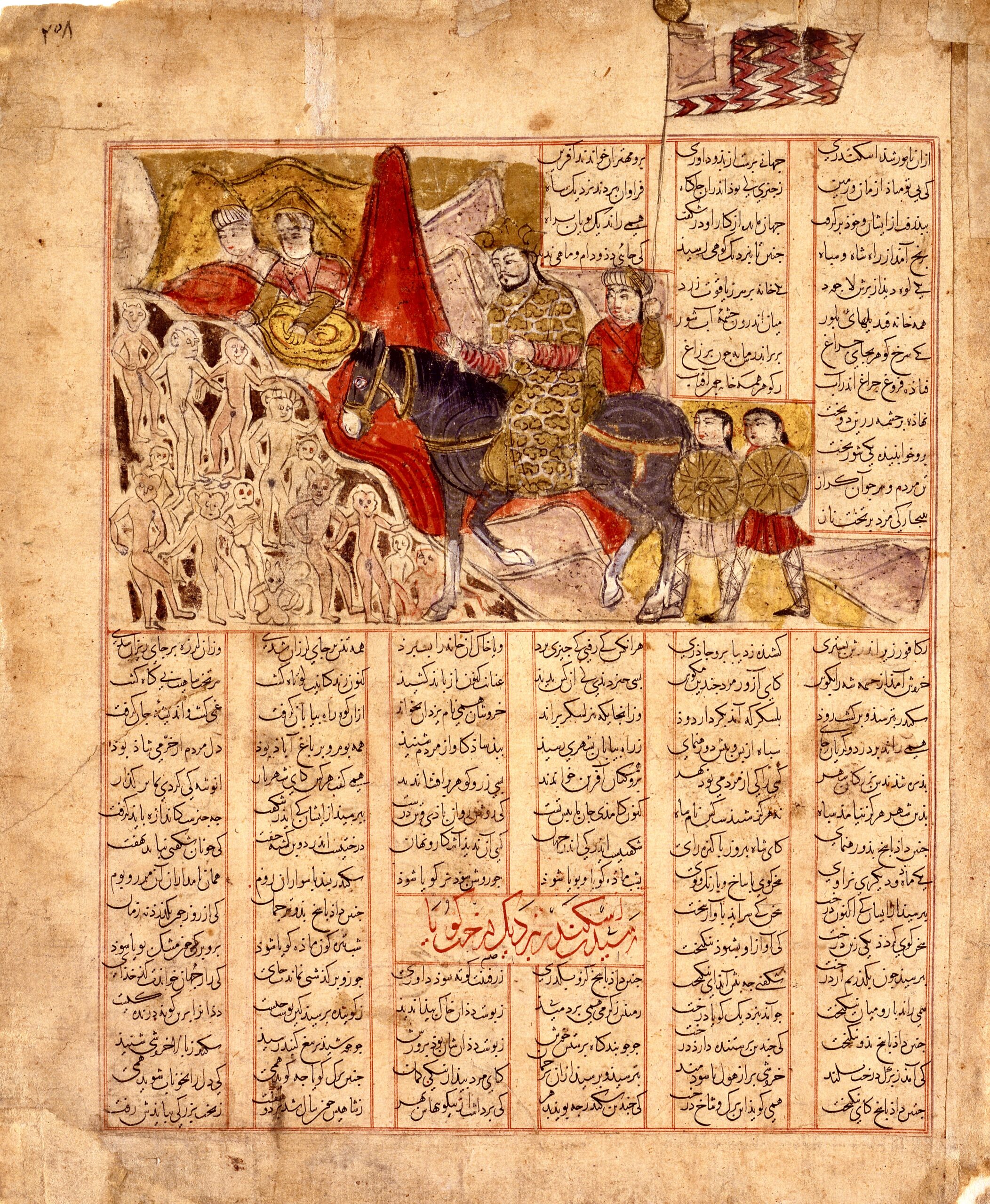
"Iskandar Contemplates the Peoples Gog and Magog", a miniature from a copy of Firdawsi’s Shahnama made for Qiwamuddawla wa’l-Din Hasan. Shiraz. 1341 AD. © The David's Collection, Copenhagen.

It took 30 years for Ferdowsi to write his masterpiece, but one does not need 30 years to read the Shahnāme, despite its daunting size. The key to understanding the Shahname lies in mastering its language — its grammar, words, and syntax. The Shahname is beautiful, elegant, inspiring, and wise, with a sophisticated simplicity that few texts can achieve. Yet, behind its simple and straightforward exterior, it hides centuries — nay, millennia — of culture and history, waiting to be uncovered by the gentle brush of a philologist.

This course is designed to do exactly that, equipping participants with the linguistic, philological, and literary tools needed to engage with the Shahname — a treasure trove of subtle poetry, Iranian philosophy, and epic.

Course Overview

This course is designed to equip participants with the tools needed for independent study of the Shahname after its completion. The readings, selected from the story of Pādešāhi-ye Eskandar in Shahname, provide participants with a deeper understanding of the Shahname’s structure and style. These readings will be conducted in the original Early Classical Persian and accompanied by detailed commentary on grammar, metre, mythology, and the etymology of key terms.

Discussions at the beginning and end of the course will further enhance participants’ understanding of the cultural, historical, and linguistic context in which the Shahname was composed. As a work rooted in pre-Islamic Iranian traditions and language, the Shahname contains layers of non-Islamic elements that cannot be fully understood without familiarity with these traditions. To address this, the instructor will highlight the text’s connections to Zoroastrian Middle Persian literary traditions and language.

Additionally, the course will tackle several common misconceptions about the Shahname and its author, providing participants with a solid foundation for engaging with this remarkable text on their own.

By participating in this course, the participants will:

  • Gain the tools for independent study of the Shahname.
  • Learn 500–600 new words in Early Classical Persian.
  • Analyze original text selections with detailed commentary on grammar, metre, mythology, and etymology.
  • Enhance their understanding of the Shahname’s stories and themes.
  • Explore the cultural, historical, and linguistic context of its composition.
  • Discover connections to Zoroastrian Middle Persian literary traditions.
  • Understand the layers of non-Islamic elements within the Shahname.
  • Discuss and clarify common misconceptions about the Shahname and its author.
  • Build a strong foundation for engaging with this literary masterpiece.

Course Structure

The classes will take place once a week over an 8-week period. Each session will last 2 hours (with a 10 minute breat), totaling 16 hours of intensive instruction on the Shahname. Each session will revolve around readings and discussions of selected passages from the Shahname. Below is a breakdown of the main activities during each class:


  • Reading of the homework passages (20 minutes)
  • Reading the text (40 minutes)
  • Break (10 minutes)
  • Reading the text (40 minutes)
  • Discussion (10–15 minutes)

During the course students will be encouraged to ask questions and discuss topics related to the content, history or any related topics to the Shahname. All questions (the more challenging the better) are highly encouraged, as they foster academic dialogue and help create a fertile environment for exploring the hidden dimensions of the text. Each participant is encouraged to actively contribute, making the discussions dynamic and enriching for everyone.

Methodology

In my courses, I employ a simple yet very effective method that combines literary, historical-linguistic, and philological approaches to clarify even the most obscure passages and words in a text.

During this course, I will draw on my expertise in pre-Islamic (Middle) Persian language and literature, as well as my familiarity of Iranian and non-Iranian languages, broader historical and geographical contexts, and, most importantly, literary contexts. This interdisciplinary approach will illuminate the meanings of words, expressions, and ideas within the text, and help participants to contextualize the text of the Shahname in its broader linguistic-philological landscape.

By explaining the underlying logic and foundations of the Shahname, this method will not only help participants understand the selections covered in the course but will also equip them with the tools to read and interpret other parts of the Shahname independently.

Testimonials

I have taken both Shahnameh and Classical Persian Prose reading courses with Ruben, and all I can say is that he is the best language teacher I have had the pleasure of learning with. He has an extraordinary ability of introducing a wide range of topics like philology, history, and geography into his language teaching, and his encylopaedic knowledge of the Iranian world (and its languages) creates a learning experience that I can confidently say is unique to him and his school.
Rohan Kaya
Faculty of Asian and Middle Eastern Studies, University of Oxford
I learned so much from Ruben’s course on the Shahnama. His depth of knowledge about Persian literary history, Middle Persian, and Persian etymology is remarkable. The reading selections were thoughtfully chosen, offering a rich and layered understanding of the text. Ruben was always ready to answer questions with clarity and insight, and his genuine joy in engaging with classical Persian literature made the learning experience all the more fun!
Ali Hassan
Ali Hassan
Department of South and Southeast Asian Studies, University of California, Berkeley, USA
Ruben was beyond exceptional as a tutor in Classical Persian, custom-designing and adapting to my interests and progress an invigorating course in its medieval historiography. He made every lesson enjoyable, and never failed to amaze with his encyclopedic knowledge of the Persian language, illuminating roots and derivations of any given word through the ages. Simply put, I could not have asked for a more inspiring and excellent teacher!
Alexander Sherborne
DPhil Student, Magdalen College, University of Oxford
I had the pleasure of attending two online Persian language courses taught by Ruben, one on the Tarix-e Beyhaqi and the other on the Shahnameh. What impressed me most was his meticulous attention to detail and his deep expertise in both historical linguistics and the literary content of the texts. His approach allowed us to explore their rich cultural and historical significance in a meaningful way, while also absorbing key notions of grammar and vocabulary. I highly recommend Ruben's classes to anyone seeking to deepen their understanding of Persian literature and language, guided by a knowledgeable, passionate, and patient teacher.
Alberto Bernard
PhD, École Pratique des Hautes Études, PSL, France
Thanks to his vast and deep familiarity with several religious, historical and literary texts written in Middle and Classical Persian, Ruben’s well-structured courses have always been intellectually stimulating and inspiring. In addition to his knowledge of secondary literature in Russian, French, German, Armenian, Persian and English, Ruben often draws on riches of the Persian literary canon to explain linguistic features. As an experienced language teacher and researcher in Iranian studies, his teaching style is an amalgam of historical linguistics and detailed philological analysis. Thanks to his helpfulness, modesty, flexibility and characteristic humor, his lessons are always engaging and entertaining. Over the years, we’ve worked together on several texts, and his intellectual impact on my own research has been truly transformative.

Kristof Szitar
PhD candidate, Université de Lausanne

FOLLOW US

CONTACT
Ruben S. Nikoghosyan (Yerevan, Armenia)

Email: nikoghosyanruben@gmail.com